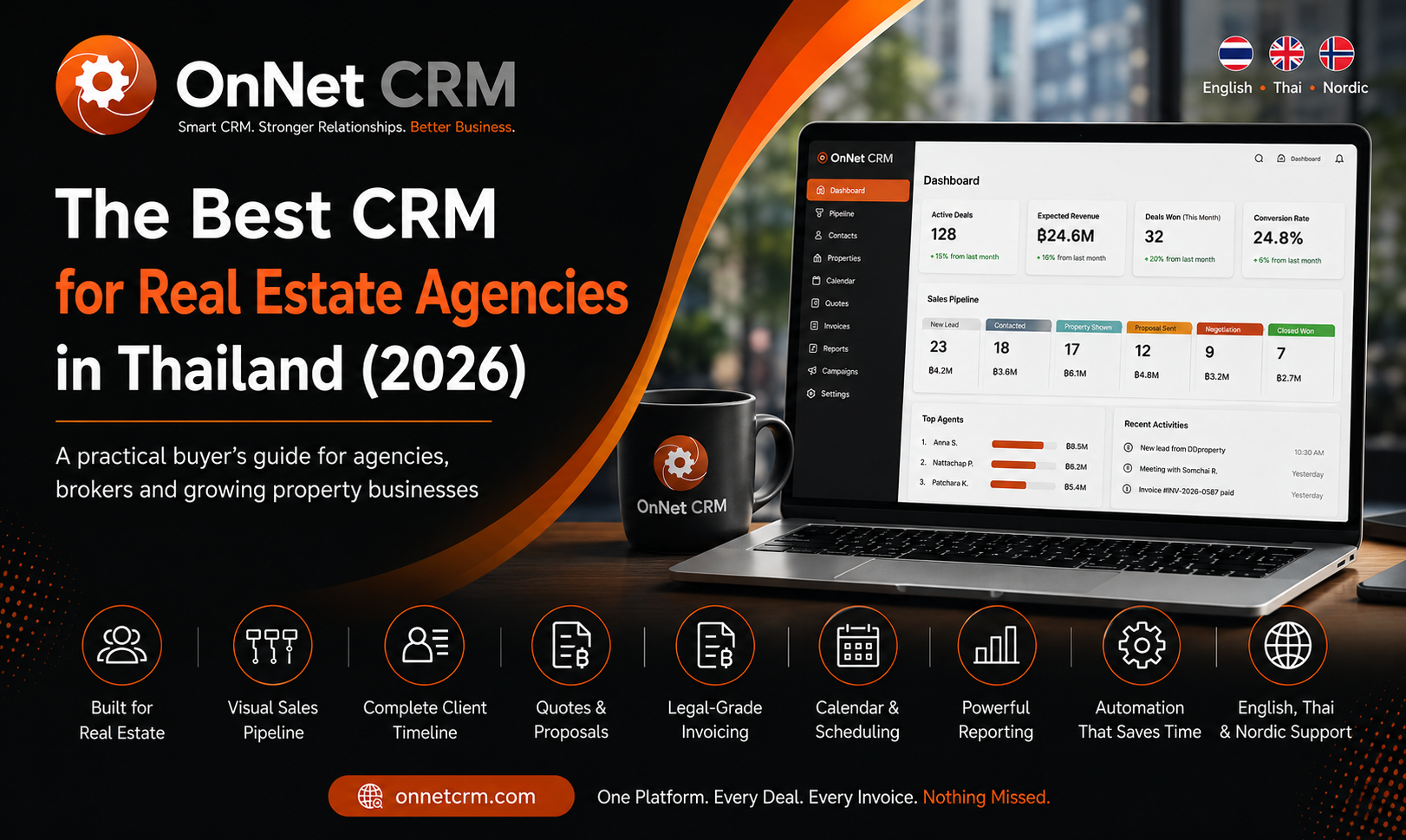
A practical buyer's guide for agencies, brokers and growing property businesses
Most "Best CRM" articles rank software by the number of features.
That's usually the wrong way to choose a CRM.
Real estate agencies don't fail because their CRM has one feature less than a competitor. They struggle because information becomes fragmented, follow-ups are missed, invoices take too long, and managers lose visibility over the sales pipeline.
The better question isn't:
Which CRM has the most features?
It's:
Which CRM actually matches the way a real estate agency works?
This guide looks at the criteria that matter most for agencies in Thailand and compares global CRM platforms with systems designed specifically for property businesses.
The seven things every real estate CRM should do
Before comparing products, decide how you'll evaluate them.
These are the seven capabilities that make the biggest operational difference for agencies.
1. Built for real estate—not adapted later
General CRMs can manage contacts.
Real estate agencies manage:
- buyers
- sellers
- landlords
- tenants
- developers
- listings
- property viewings
- negotiations
- commissions
A CRM designed specifically for property businesses understands these relationships without requiring months of customization.
2. Complete sales pipeline visibility
Managers should never need to ask:
"Where is this deal?"
- Every opportunity should appear in one visual pipeline showing:
- current stage
- responsible agent
- estimated value
- last activity
- next follow-up
- Without this visibility, forecasting becomes guesswork.
3. One client profile for the whole agency
Clients don't remember which agent they spoke to. They remember your agency.
A proper CRM keeps:
- phone calls
- emails
- notes
- meetings
- proposals
- invoices
When an agent is unavailable, another team member can continue the conversation immediately.
4. Quotes and invoices connected to sales
Many agencies still create quotations in Word and invoices in accounting software.
That creates:
- duplicate data entry
- version control problems
- invoice errors
- slow response times
- A modern CRM should generate quotations and invoices directly from the deal.
5. Built-in reporting
Agency owners should know:
- active deals
- expected revenue
- conversion rates
- agent performance
- monthly sales
- stalled opportunities
- without exporting spreadsheets every Friday.
Good reporting saves management time every week.
6. Automation instead of administration
Real estate professionals should spend time selling.
Not:
- copying contact details
- updating spreadsheets
- writing reminder notes
- searching email threads
- recreating documents
- Automation is one of the largest productivity gains a CRM provides.
7. Easy enough that the whole team actually uses it
The best CRM isn't the one with the biggest feature list.
It's the one your entire team adopts.
If agents avoid using the system because it's complicated, the CRM fails regardless of its capabilities.
The market, grouped honestly
Rather than ranking products from one to ten, it's more useful to group them by where they fit.
Global CRM platforms
HubSpot
- Excellent marketing automation and sales management platform.
- Best suited for companies wanting enterprise marketing capabilities.
- Real estate workflows usually require significant customization.
Salesforce
- The most powerful CRM on the market.
- Also the most complex.
- Ideal for large enterprises with dedicated implementation partners.
- Often excessive for small and medium-sized agencies.
Zoho CRM
- Flexible and affordable.
- Strong general business CRM with many integrations.
- Property workflows typically need additional configuration.
- Pipedrive
- Pipeline-focused and easy to use.
- Excellent sales tracking.
- Less specialized for property listings, agency operations and invoicing.
Property-focused CRM solutions
- Several regional CRM platforms are built specifically for real estate.
- These usually provide combinations of:
- listing management
- agent management
- sales pipeline
- commission tracking
- property workflows
- Always verify exactly which functions are included in your plan before purchasing.
OnNet CRM
OnNet CRM was designed specifically for real estate agencies rather than general businesses.
Instead of combining multiple disconnected systems, it brings the agency's commercial workflow together in one platform, including:
- Sales Pipeline
- Contact & Account Management
- Quote Builder
- Legal-Grade Automated Invoicing
- Calendar & Scheduling
- Email Campaigns
- Business Registry Enrichment
- White Label Branding
- Analytics & Reporting
- REST API & Webhooks
- Role-based access
- English, Thai, and Nordic language support
Rather than focusing on feature quantity, the platform focuses on reducing administrative work while improving visibility across the agency. These capabilities align with the published product roadmap and campaign materials.
The verdict
There is no universal "best CRM."
Large international property companies with dedicated IT teams may benefit from highly customizable enterprise platforms like Salesforce or HubSpot.
Agencies that primarily need marketing automation across multiple industries may find a general CRM sufficient.
But for small and medium-sized real estate agencies, the daily challenges are remarkably consistent:
- leads scattered across multiple channels
- incomplete client history
- missed follow-ups
- poor pipeline visibility
- manual quotations
- disconnected invoicing
- too much administrative work
- Those aren't accounting problems.
They aren't marketing problems.
They're workflow problems.
A CRM designed specifically around how real estate agencies sell property removes much of that operational friction.
For agencies looking for one platform to manage clients, sales, quotations, invoicing and reporting together, OnNet CRM offers a focused approach built around the day-to-day realities of property businesses rather than generic customer management.